
Grow Young With Us
Copper peptides get sold hard in serum form and discussed seriously in clinics. The gap between those two conversations is where most of the confusion lives.
Quick Answer
GHK-Cu supports hair growth indirectly — by improving the scalp environment, stimulating collagen, and supporting follicle-level blood supply — rather than by blocking the hormone that causes pattern hair loss. That makes it a supportive treatment, usually combined with PRP, stem cell therapy or a transplant, not a standalone replacement for minoxidil or finasteride. Vials run $199–$599 at Beyond Stem Cells in Littleton, serving Denver. Call 1-833-720-7836.
- GHK-Cu is a support treatment, not a DHT blocker — it does not address the hormonal driver of pattern loss.
- It is used for scalp quality, collagen, and perifollicular blood supply.
- Injectable delivery reaches the follicle level; topical serums face a skin-penetration ceiling.
- Expect a 3–6 month horizon before judging anything — hair cycles are slow.
- It works alongside minoxidil rather than replacing it; the two do different jobs.
- Vials run $199–$599; it is also a component of the GLOW blend.
Vials $199–$599
Pairs with PRP
Littleton, CO · serving Denver
What GHK-Cu Does at the Hair Follicle
GHK-Cu is a copper-binding tripeptide that stimulates collagen production, supports the formation of small blood vessels, and influences the tissue-repair signaling around the follicle. Follicles do not sit in isolation — they sit in dermal tissue with a blood supply, a collagen scaffold, and an inflammatory tone. GHK-Cu acts on that surrounding environment.
What it does not do is worth stating plainly, because it is the single most common misunderstanding: GHK-Cu does not block DHT. In androgenetic hair loss, dihydrotestosterone progressively miniaturizes susceptible follicles. A treatment that improves the neighborhood does not stop the process that is shrinking the house. That is why GHK-Cu belongs in a combination protocol.
Copper Peptide for Hair Loss: Injectable vs Topical
The difference between injectable and topical GHK-Cu is delivery, and delivery is most of the argument. The scalp’s outer layer is a barrier by design. A peptide has to cross it to reach the dermal environment around the follicle, and molecule size and formulation determine how much actually does.
| Injectable (clinic) | Topical serum (retail) | |
|---|---|---|
| Delivery depth | Reaches the dermal level directly | Limited by skin barrier penetration |
| Dose control | Prescribed and measured | Whatever the bottle says |
| Oversight | Physician-supervised | None |
| Common use | Alongside PRP, stem cell therapy or a transplant | Daily home maintenance |
| Cost structure | $199–$599 per vial | Per bottle, ongoing |
Microneedling sits between the two — it creates transient channels that improve topical penetration, which is why microneedling often appears in combination protocols. Our full GHK-Cu copper peptide guide covers the skin side of the same molecule.
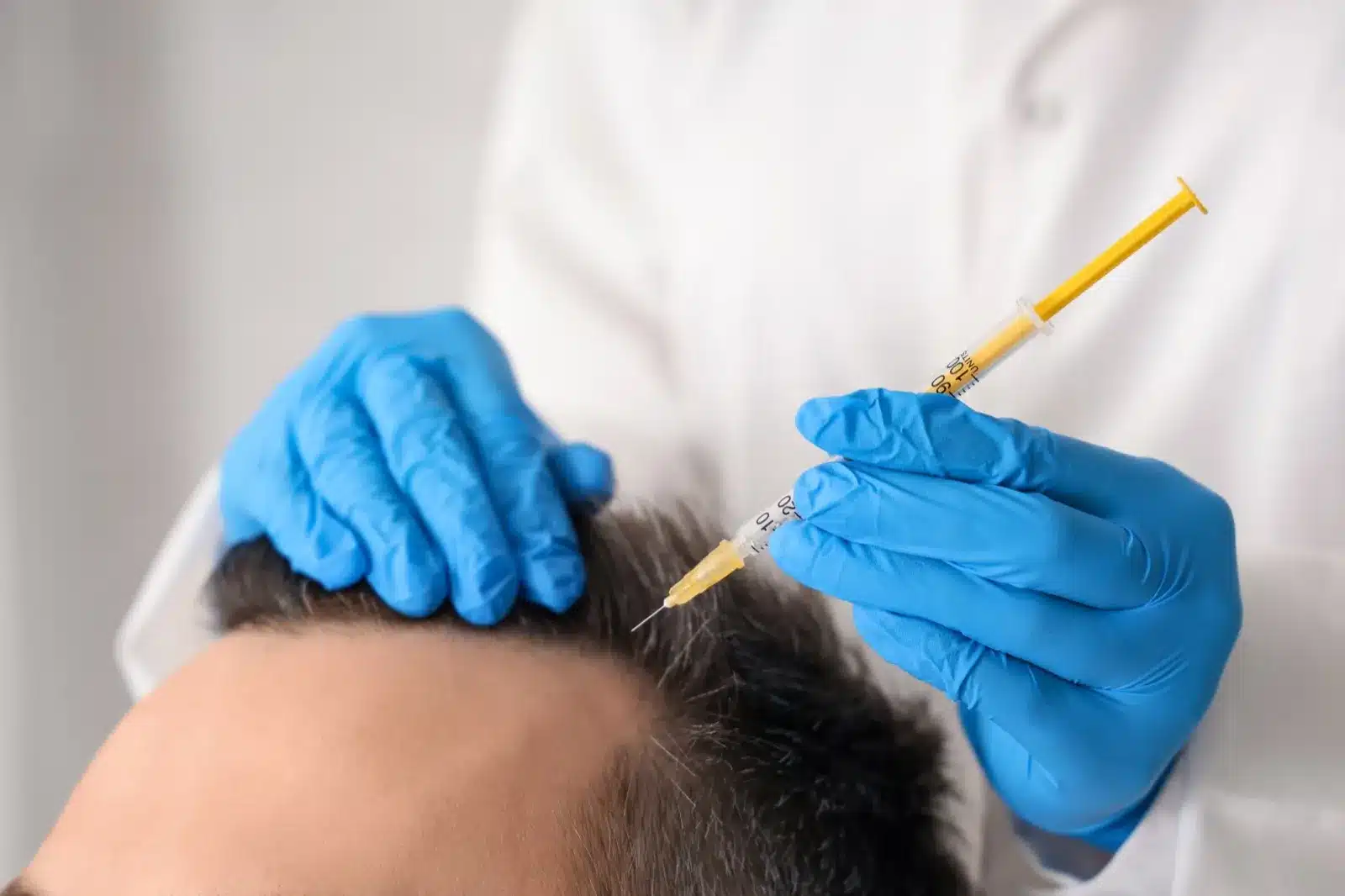
GHK-Cu Results Timeline: Month by Month
Hair grows on a biological clock you cannot negotiate with — roughly a centimeter a month, in cycles. Any honest timeline reflects that:
- Month 1: scalp comfort and reduced irritation are the most commonly reported early changes. No visible density change. Expect nothing here.
- Month 2: some patients report less shedding. This is subjective and easy to misread — count what is in the drain, not what you feel.
- Month 3: the earliest realistic point for fine new growth to become visible, usually as short wispy hairs at the hairline or part.
- Months 4–6: the assessment window. Standardized photos in the same lighting are the only way to judge this honestly.
- Beyond 6 months: continuation is a maintenance decision. Gains from any hair treatment recede if the underlying driver is untreated.
GHK-Cu vs Minoxidil
They are not alternatives — they act on different parts of the problem. Minoxidil is an FDA-approved topical treatment for pattern hair loss that works largely by extending the growth phase of the hair cycle and improving follicular blood flow, with decades of human data behind it. GHK-Cu is a compounded peptide used to support the tissue environment, without FDA approval for hair loss.
| GHK-Cu | Minoxidil | |
|---|---|---|
| FDA status for hair loss | Not approved; compounded | FDA-approved topical |
| Main action | Tissue environment, collagen, perfusion | Prolongs growth phase |
| Evidence base | Limited human data for hair | Extensive human data |
| Addresses DHT | No | No |
| Typical role | Adjunct, often peri-procedure | Foundation of medical management |
The reasonable framing: minoxidil (and, where appropriate, a DHT-directed medication) is the medical baseline. GHK-Cu is something you add when the goal includes scalp quality and healing — especially around a procedure.
Using GHK-Cu Alongside PRP or a Transplant
This is where copper peptides earn their place: supporting healing and perfusion when the scalp has just been treated. Beyond Stem Cells already builds a pre-treatment step into every FUE procedure — a stem cell or PRP scalp treatment about two weeks before surgery — on the logic that a better-perfused scalp is a better host for grafts.
- With PRP or stem cell therapy: layered into a hair restoration protocol targeting density in still-living follicles.
- Around an FUE transplant: used in the healing window; the transplant relocates hair, the supportive treatments look after everything else.
- Inside the GLOW blend: GHK-Cu is one of three peptides in the GLOW blend, alongside BPC-157 and TB-500.
If you are deciding between approaches rather than stacking them, our comparison of stem cell hair restoration vs FUE is the better starting point.
What GHK-Cu Costs
GHK-Cu vials run $199–$599 at Beyond Stem Cells, priced by vial size and concentration, with dosing individualized at consultation. If GHK-Cu is being used as part of a blend rather than alone, pricing follows the same per-vial structure — our glow peptide cost guide breaks that down in detail.
— Beyond Stem Cells, peptide therapy program
Frequently Asked Questions
Does GHK-Cu regrow hair?
GHK-Cu supports hair growth indirectly by improving the scalp environment, stimulating collagen and supporting blood supply around the follicle. It does not block DHT, the hormone driving pattern hair loss, so it is used as part of a combination protocol rather than as a standalone regrowth treatment.
Is injectable GHK-Cu better than a topical copper peptide serum?
Injectable delivery reaches the dermal level around the follicle directly, while topical serums are limited by the skin barrier. Injectable use is physician-supervised with prescribed dosing; retail serums are not.
How long does GHK-Cu take to show results for hair?
Little is visible before month three. Months four through six are the realistic assessment window, and standardized photos taken at baseline are the only reliable way to judge change.
Is GHK-Cu better than minoxidil?
They do different jobs. Minoxidil is FDA-approved for pattern hair loss with extensive human data and prolongs the growth phase. GHK-Cu is a compounded peptide supporting the tissue environment, without FDA approval for hair loss. They are commonly used together rather than as substitutes.
How much does GHK-Cu cost?
Vials run $199 to $599 at Beyond Stem Cells depending on size and concentration, with dosing set individually at consultation.
Build a Hair Protocol That Fits Your Pattern
Free consultation covering peptides, PRP, stem cell therapy and FUE — and which combination your scalp actually needs.
Call 1-833-720-7836 (24/7) · Book a free consultation
5912 S Cody St Suite 201, Littleton, CO 80123 · Mon–Sat 9:00 AM–5:00 PM MST
Find us on Google Maps
Medical disclaimer: GHK-Cu is not an FDA-approved drug for hair loss; it is a compounded substance used under physician supervision. Minoxidil is FDA-approved and referenced here for comparison only. This article is educational and is not medical advice. Individual results vary and no outcome is guaranteed. Always consult a licensed physician about your own situation. Prices shown are current as of August 14, 2026 and are subject to change.