
Best Way to Take BPC-157: The Complete Guide to Dosing and Administration
Physician-supervised • Pharmaceutical-grade peptides from licensed compounding pharmacies
Have a question about your own situation? Beyond Stem Cells is a physician-led regenerative medicine clinic in Littleton, CO. A consultation is the fastest way to find out what applies to you.
TL;DR
The best way to take BPC-157 for most people is a daily subcutaneous injection of 250–500 mcg, delivered into the subcutaneous fat near the injury site, for a 4–8 week cycle for acute injuries or 8–12 weeks for chronic conditions. For gut and digestive issues, oral BPC-157 at 500–1,000 mcg daily works well because the peptide directly contacts the GI lining. Reconstitute a 5 mg vial with 2 mL bacteriostatic water (so 0.1 mL = 250 mcg), refrigerate, and inject at the same time daily for consistency. Most patients see meaningful improvement in 4–8 weeks. BPC-157 is not FDA-approved and should be used under physician supervision with pharmaceutical-grade peptides from licensed compounding pharmacies — which is exactly how Beyond Stem Cells delivers it in Littleton, CO.
⚡ Quick-Answer Summary
Standard dose: 250–500 mcg/day subcutaneous • Cycle: 4–12 weeks • Reconstitution: 2 mL bacteriostatic water per 5 mg vial • Storage: refrigerated, 2–4 weeks stability • Best for: tendon, ligament, muscle, and gut healing • Top stack: BPC-157 + TB-500 for soft-tissue injuries.
What BPC-157 Actually Is (And Why Dosing Matters)
BPC-157 stands for Body Protection Compound 157 — a synthetic 15-amino-acid peptide derived from a protective protein naturally found in human gastric juice. It first drew research interest for its ability to heal stomach ulcers and inflammatory bowel conditions, then expanded to tendon, ligament, muscle, and even bone healing across dozens of preclinical studies (Sikiric et al., PubMed).
The challenge is that BPC-157 information online is a mess — Reddit threads, YouTube speculation, and supplement-company copy that contradict each other. This guide cuts through that with the clinical protocols Beyond Stem Cells actually uses, the math behind the doses, and the safety boundaries that matter.
How BPC-157 Works (in Plain English)
BPC-157 supports healing through four overlapping mechanisms: it promotes angiogenesis (new blood vessel growth into damaged tissue), upregulates growth factors involved in tissue repair, modulates inflammation from chronic to resolution-phase, and protects cells from various stressors. Together, these effects accelerate the body's existing healing machinery rather than override it.
Is BPC-157 FDA-Approved?
No. BPC-157 is not FDA-approved for any medical condition and is not a controlled substance. In late 2023 the FDA placed BPC-157 on the 503A bulks list "Category 2," which limits compounding pharmacy access. It can still be obtained through licensed compounding pharmacies under physician supervision, which is how Beyond Stem Cells sources it. Avoid "research peptides" sold from unverified online vendors — purity and potency vary wildly.
Injectable vs Oral vs Nasal: Which Route Is Best?
The first decision is route of administration. Each has distinct pros and cons.
| Route | Bioavailability | Best For | Typical Dose | Trade-Off |
|---|---|---|---|---|
| Subcutaneous Injection | High | Tendon, ligament, muscle, joint, systemic | 250–500 mcg/day | Requires needle skill |
| Oral Capsule | Lower (digestive breakdown) | Gut, digestive lining, IBD, leaky gut | 500–1,000 mcg/day | Less reliable for tendon/ligament |
| Nasal Spray | Uncertain (limited data) | Convenience-driven users | Varies by formulation | Inadequate clinical data; nasal irritation |
| Intramuscular Injection | High | Deep targeted delivery | 250–500 mcg/day | More technique-dependent |
The Clinical Default at Beyond Stem Cells
For tendinopathy, ligament sprains, muscle injuries, joint pain, and most systemic indications, we default to subcutaneous injection. It produces the most consistent results, allows precise dose titration, and matches the route used in nearly all preclinical research. For inflammatory bowel disease, ulcers, and gut-permeability issues, we'll use oral BPC-157 — sometimes alongside injections.
Exact BPC-157 Dosing Protocols (By Indication)
| Condition | Route | Daily Dose | Frequency | Cycle Length |
|---|---|---|---|---|
| Acute tendon/ligament injury | Subcutaneous | 500 mcg | Once daily | 4–6 weeks |
| Chronic tendinopathy | Subcutaneous | 250–500 mcg | Once daily | 8–12 weeks |
| Muscle strain | Subcutaneous | 250–400 mcg | Once daily | 3–6 weeks |
| Joint pain / mild OA | Subcutaneous | 300–500 mcg | Once daily | 6–10 weeks |
| Ulcerative colitis / IBD | Oral (± injection) | 500–1,000 mcg | 1–2× daily | 8–12 weeks |
| Leaky gut / GI inflammation | Oral | 500 mcg | 2× daily | 6–8 weeks |
| Post-surgical recovery | Subcutaneous | 500 mcg | Once daily | 4–6 weeks |
| General maintenance | Subcutaneous | 200–250 mcg | Once daily, 5 days/week | Ongoing in cycles |
What About Weight-Based Dosing?
Unlike many peptides, BPC-157 is not strongly weight-dependent. A 150-pound and a 250-pound patient typically use similar doses because the mechanism is signaling-based rather than concentration-based. We adjust by indication and severity, not body mass.
Loading Doses, Cycling, and Breaks
BPC-157 doesn't require a loading dose. Steady daily dosing is the standard. We typically recommend a 2–4 week break after 8–12 weeks on for chronic protocols — the necessity isn't fully established, but it's a sensible conservative approach for long-term use.
Not sure which of these protocols fits you? Dose, route, and cycle length change with the injury, the tissue, and what else you're taking. A consultation replaces the guesswork with a written protocol.
BPC-157 Reconstitution: The Math (Made Simple)
BPC-157 typically arrives as a lyophilized (freeze-dried) powder in a 5 mg vial. You'll need bacteriostatic water (BAC water, not regular sterile water — the benzyl alcohol prevents bacterial growth in multi-dose vials).
📐 The Standard Reconstitution
5 mg vial + 2 mL bacteriostatic water = 2,500 mcg per mL.
That means: 0.1 mL on an insulin syringe = 250 mcg • 0.2 mL = 500 mcg.
Step-by-Step Reconstitution
Step 1: Sanitize
Wash hands. Wipe the BPC-157 vial top and BAC water vial top with separate alcohol swabs. Let them air-dry for 5 seconds.
Step 2: Draw the Diluent
Using a 3 mL syringe with a drawing needle, pull up 2 mL of bacteriostatic water.
Step 3: Add Slowly
Insert the needle into the BPC-157 vial at a 45° angle. Inject the water slowly down the inside wall of the vial — never directly onto the powder, which can degrade the peptide.
Step 4: Swirl (Don't Shake)
Gently swirl the vial in your palm until the solution is fully clear. Never shake — agitation damages the peptide chain.
Step 5: Label and Refrigerate
Write the reconstitution date on the vial. Store upright in the refrigerator (35–46°F). Use within 2–4 weeks. Discard if cloudy, discolored, or past the window.
Injection Technique: Subcutaneous BPC-157, Step by Step
What You'll Need (Per Injection)
- Reconstituted BPC-157 vial
- One sterile insulin syringe (29–31 gauge, 0.3–0.5 mL)
- Two alcohol swabs
- Sterile gauze pad
- Sharps container for disposal
- Wash hands with soap and water for 20 seconds.
- Wipe the vial top with an alcohol swab; let air-dry.
- Draw your dose. Pull air into the syringe equal to your dose volume, inject it into the vial, then invert and draw up your dose (typically 0.1–0.2 mL).
- Tap out air bubbles and push them back into the vial.
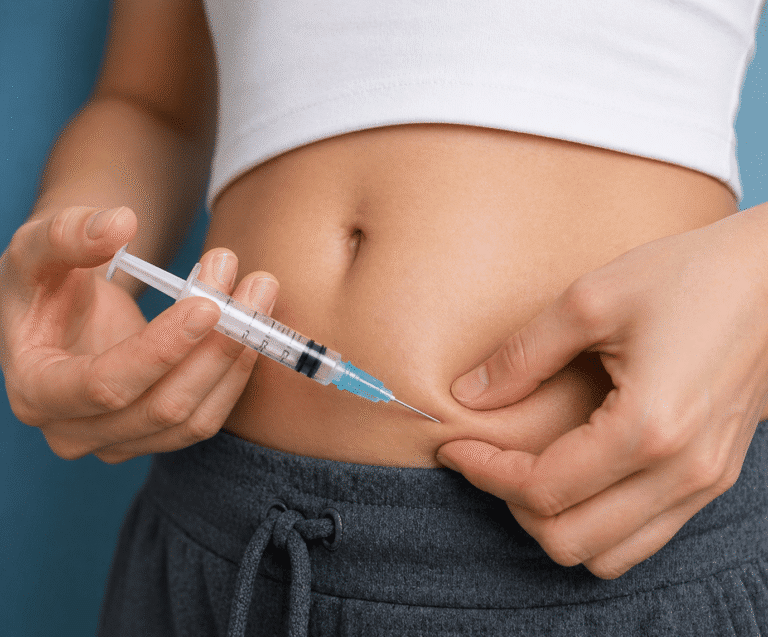
- Choose an injection site with pinchable subcutaneous fat: lower abdomen (avoid 2 inches around the navel), love handles, outer thigh, or back of upper arm.
- Clean the site with an alcohol swab; let it air-dry.
- Pinch the skin, insert the needle at a 45–90° angle, and inject slowly over 3–5 seconds.
- Withdraw the needle and apply gentle pressure with sterile gauze if needed.
- Dispose of the syringe in a sharps container.
Best Time of Day
The research doesn't favor any specific timing. Consistency matters more than timing — pick a clock-time you'll actually keep (morning coffee, post-workout, before bed) and stick with it. Splitting into twice-daily injections is reasonable at higher daily totals (e.g., 250 mcg AM + 250 mcg PM at a 500 mcg/day total).
Site Rotation
Rotate sites every injection to prevent local irritation and lipohypertrophy. A simple 4-site rotation (left abdomen → right abdomen → left love handle → right love handle) works for most patients.
Oral BPC-157: When and How
Oral BPC-157 makes the most sense for gut-focused indications — ulcers, IBD, leaky gut, gastritis — because the peptide passes directly through the inflamed tissue you're trying to heal.
Oral Protocol Essentials
- Standard dose: 500–1,000 mcg, 1–2× daily
- Empty stomach for systemic effects: 30–60 minutes before meals or 2 hours after
- With food for gut-coating effects: take alongside meals
- Storage: capsules should be refrigerated; check supplier guidance
- Quality: oral BPC-157 degrades faster — only buy from physician-verified compounding pharmacies
BPC-157 Side Effects and Safety
BPC-157 has a remarkably favorable side-effect profile in published animal data and human clinical use. When side effects occur, they're typically mild and short-lived.
| Side Effect | Frequency | Management |
|---|---|---|
| Injection-site redness or mild bruising | Common | Rotate sites; warm compress |
| Mild fatigue first few days | Uncommon | Self-limited; resolves in 3–5 days |
| Headache | Rare | Hydration; reduce dose if persistent |
| Mild GI upset (oral route) | Rare | Take with food |
| Flushing or warmth | Very rare | Self-limited |
Who Should NOT Use BPC-157
- Pregnant or breastfeeding women — insufficient safety data
- Active or recent cancer — theoretical angiogenesis concern
- Uncontrolled bleeding disorders
- Known peptide allergy
- Uncontrolled severe cardiovascular disease — without specialist clearance
Drug Interactions
Formal interaction data is limited. Theoretical concerns exist with anticoagulants, blood pressure medications, and immunosuppressants. Disclose every medication and supplement at consultation.
Screening matters as much as dosing. Before a first injection, a provider should review your history, current medications, and the contraindications above. That review is part of every peptide program at Beyond Stem Cells.
Best BPC-157 Stacks (Physician-Supervised)
1. BPC-157 + TB-500 — The Soft-Tissue Healer
The most popular stack for tendon, ligament, and muscle injuries. TB-500 promotes cell migration, BPC-157 promotes angiogenesis and inflammation control. Together they outperform either alone.
Protocol: BPC-157 250–500 mcg daily SC + TB-500 2–5 mg twice weekly SC, 4–8 week cycle.
2. BPC-157 + GHK-Cu — Skin and Connective Tissue
GHK-Cu (copper peptide) promotes collagen synthesis and skin remodeling. Combined with BPC-157, useful for surgical scar healing, wound recovery, and dermal-deep injuries.
Protocol: BPC-157 250 mcg daily SC + GHK-Cu topical or SC per dermatologic protocol.
3. BPC-157 + Sermorelin or CJC-1295/Ipamorelin — Whole-Body Recovery
Adding a growth hormone secretagogue boosts the broader anabolic environment that supports tissue healing. Popular among athletes and post-surgical patients.
Protocol: BPC-157 250–500 mcg daily SC + CJC-1295/Ipamorelin 100 mcg each at bedtime SC.
4. BPC-157 + Oral Collagen Peptides — Building Blocks Stack
BPC-157 signals tissue repair; collagen provides amino acid substrate. Cheap, simple, and stackable with any of the above.
Protocol: BPC-157 per indication + 10–20 g hydrolyzed collagen peptides daily.
The 7 Most Common BPC-157 Mistakes (and How to Avoid Them)
- Buying from unverified "research" vendors. Purity, potency, and contamination vary wildly. Use only physician-sourced compounding pharmacy product.
- Inconsistent daily dosing. Skipping days breaks the steady tissue-level signaling that drives results.
- Quitting too early. Most conditions need 4–8 weeks minimum. Two weeks isn't a fair trial.
- Reconstituting wrong. Using regular sterile water (no preservative), shaking instead of swirling, or storing at room temp degrades the peptide fast.
- Using BPC-157 as a standalone fix. It supports healing — it doesn't replace rest, rehab, sleep, and protein intake.
- Injecting in only one site. Causes lipohypertrophy. Rotate.
- Expecting overnight results. Tissue healing takes weeks. Patience and protocol adherence win.
Most of those seven mistakes disappear with supervision. We supply pharmaceutical-grade peptide and sterile injection kits, hand you a dosing chart, and follow up — so you're not doing reconstitution math at the kitchen counter.
What Realistic Results Look Like
Most patients on a clinically appropriate BPC-157 protocol report a recognizable pattern: weeks 1–2, subtle inflammation reduction; weeks 3–4, noticeable functional improvement (better range of motion, less morning stiffness); weeks 5–8, meaningful pain reduction and tissue tolerance gains; weeks 8–12, deeper structural healing and the ability to return to higher-load activity.
About 10–20% of patients are non-responders or modest responders. We typically reassess at week 4 — if there's no movement at all, we look at quality of the product, technique, dose, and whether another peptide or therapy is a better fit.
Why Patients Choose Beyond Stem Cells for BPC-157
- Pharmaceutical-grade peptides from licensed compounding pharmacies — not gray-market vendors.
- Pre-calculated dosing instructions so you never guess at concentration math.
- Hands-on injection training at your first visit.
- Integrated protocols — BPC-157 paired with PRP, stem cell therapy, peptide stacks, or rehab when indicated.
- Progress monitoring at weeks 4, 8, and 12 with protocol adjustment.
- Denver metro convenience — Littleton, CO location serving the entire metro area.
Frequently Asked Questions
What is the best way to take BPC-157?
What is the standard BPC-157 injectable dose?
How do I reconstitute a 5 mg BPC-157 vial?
Is oral or injectable BPC-157 better?
How long until I see results?
Is BPC-157 FDA-approved?
Can BPC-157 be stacked with TB-500?
How long does reconstituted BPC-157 last?
What are the side effects?
Where can I get BPC-157 in Denver?
Free Book — Instant Download
Beyond Stem Cells: The Regenerative Medicine Guide
Go deeper than one protocol — the full guide to peptides, stem cell therapy, and regenerative treatment, free and instant.
Get the Free BookRelated Reading from Beyond Stem Cells
- Peptide Therapy at Beyond Stem Cells — full overview of our peptide programs and protocols.
- Best Peptides to Increase Testosterone — for hormone-optimization stacks alongside BPC-157.
- Best Injectable Peptide for Weight Loss for 2026 — when fat loss and tissue healing are dual goals.
- Elbow Pain Treatment — BPC-157 is often paired with regenerative injections for tendinopathy.
Outside References
- Sikiric P, et al. "Stable Gastric Pentadecapeptide BPC 157 — clinical applications." PubMed. pubmed.ncbi.nlm.nih.gov/29782846
- Chang CH, et al. "The promoting effect of pentadecapeptide BPC 157 on tendon healing." NIH PubMed Central. ncbi.nlm.nih.gov/pmc/articles/PMC3206257
- Sikiric P, et al. "BPC 157 and inflammatory bowel disease." NIH PMC. ncbi.nlm.nih.gov/pmc/articles/PMC7345585
- U.S. Food & Drug Administration. "Bulk Drug Substances Used in Compounding — 503A." fda.gov
Ready to Take BPC-157 the Right Way?
Schedule a consultation at Beyond Stem Cells in Littleton, CO. We'll match your condition to the right protocol, supply pharmaceutical-grade peptide and sterile injection kits, and walk you through every step — from first injection to follow-up.