
Grow Young With Us
A graft is not a hair. Once you understand what a hair graft clinic is actually counting, every quote you get starts to make sense.
You have been quoted “2,000 grafts” by one clinic and “1,200 grafts” by another, and nobody explained what a graft is or why the numbers differ. This guide explains what a hair graft clinic does, what grafts cost, and the questions that separate a careful clinic from a sales floor.
Quick Answer
A hair graft is one follicular unit of one to four hairs. A hair graft clinic moves these units, one at a time, from the back and sides of the scalp to a thinning area. Beyond Stem Cells performs FUE grafting with the AuraGraft™ system at its Littleton, CO clinic for $4 per graft, with a free consultation and a written graft estimate.
- A graft is a follicular unit, not a single hair. One graft holds 1 to 4 hairs, so 2,000 grafts is often 4,000+ hairs.
- Grafts are priced individually. National FUE rates run about $3 to $8 per graft. Beyond Stem Cells charges $4 per graft and includes a stem cell or exosome scalp treatment one week before the FUE at no extra charge.
- Most cases need 1,000 to 3,000 grafts, set by donor density and how far loss has progressed, measured in person.
- Judge a clinic by its answers: who performs the extraction, who oversees it, whether the quote is written, and whether they refuse to promise a success rate.
- Timeline: transplanted hairs often shed in weeks 1 to 3, new growth is typically visible at 3 to 4 months, and full results usually show at 12 to 18 months.
- Where: Beyond Stem Cells, 5912 S Cody St, Suite 201, Littleton, CO 80123, serving Denver, Littleton, Englewood, Highlands Ranch, Centennial, Lakewood, Ken Caryl, Columbine, Lone Tree.
Here is what is inside a graft, how the count is estimated, and the six questions to bring to any consultation.
What does a hair graft clinic actually do?
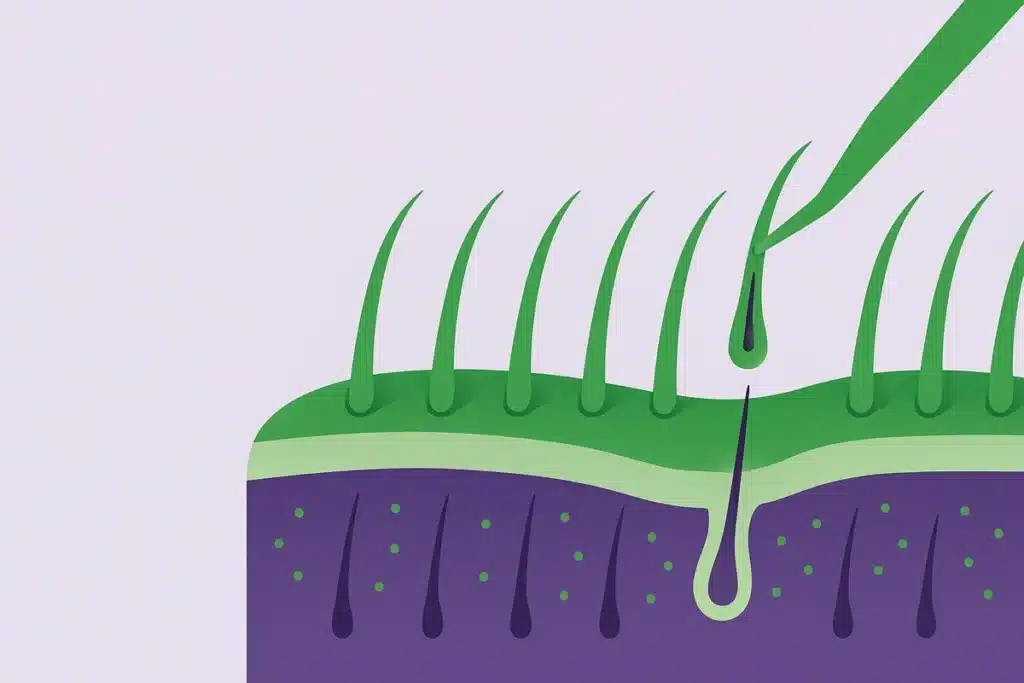
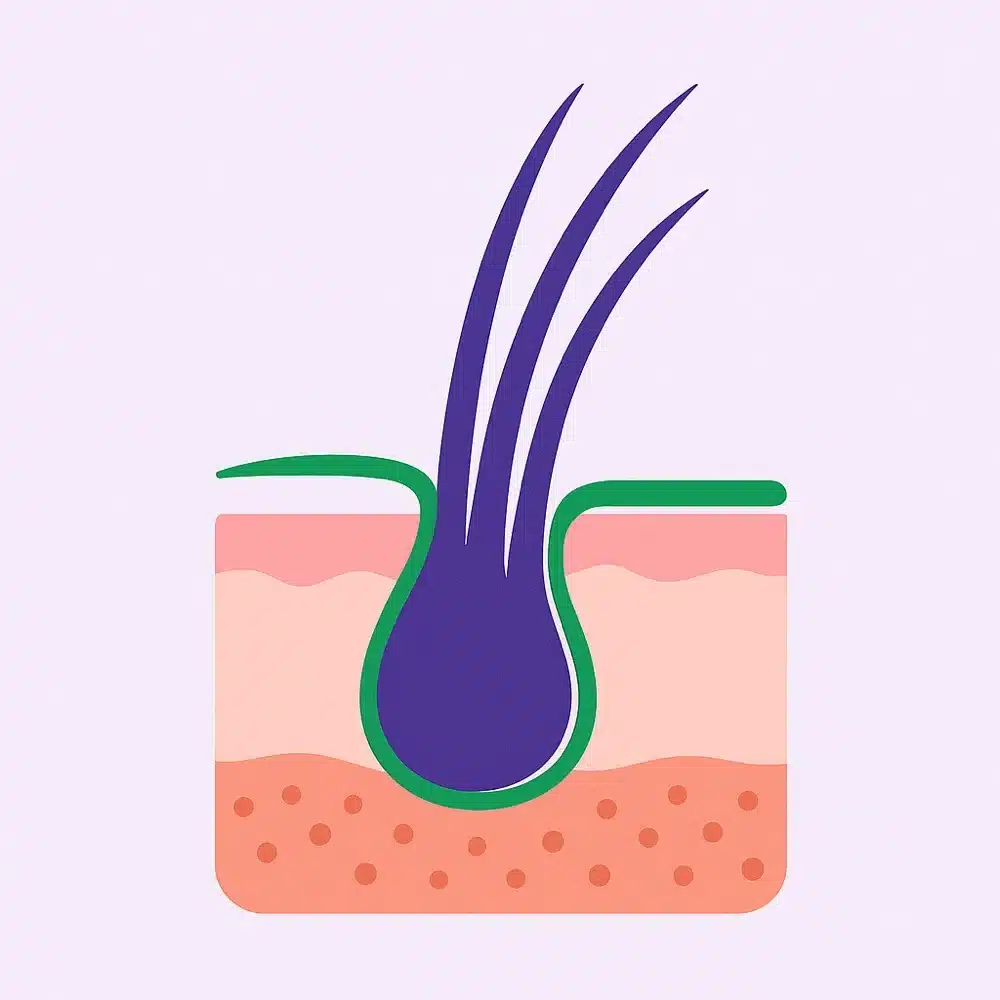
A hair graft clinic harvests follicular units from a donor area and places them where hair has stopped growing. The word “graft” is borrowed from general surgery: a graft is living tissue moved from one place to another on the same body. In hair restoration, each graft is a tiny plug of scalp that contains the hair follicle, its root, the oil gland, and the small muscle and blood supply that keep it alive.
Follicles on the scalp grow in natural groupings. Most units hold two or three hairs; some hold one, some hold four. This is why graft count and hair count are different numbers, and why a clinic that quotes hairs instead of grafts is making the job sound bigger than it is. It is also why a technician’s skill matters: keeping each unit intact during extraction is the whole game.
FUE grafting, step by step
Beyond Stem Cells uses FUE (Follicular Unit Extraction), performed with the AuraGraft™ system, an FDA-cleared automated device. The full procedure page is at FUE Hair Transplant in the Denver Metro. In brief:
- Consultation and evaluation. A complimentary visit measures your donor supply and the extent of loss, and decides whether FUE, a non-surgical option, or a combination fits your goals.
- Extraction. Individual follicular units are removed one at a time from the donor area, typically the back and sides of the scalp, under local anesthesia. Because grafts are taken individually rather than as a strip, there is no linear scar.
- Placement. Grafts are placed into the thinning or bald area unit by unit, following a natural hairline and growth direction.
- Recovery and follow-up. Most patients resume normal activity within days. Aftercare guidance and follow-up appointments carry you through the shed-and-regrowth cycle.
A session runs 4 to 8 hours, or up to 12 hours for a mega session involving thousands of graft units in one sitting. Donor-area hair carries the same DHT resistance it had at the back of the head, so transplanted follicles are permanent placement. That does not stop ongoing loss in areas that were not transplanted, which is why the consultation also covers prevention for the rest of the scalp.
FDA-cleared device
No linear scar
Local anesthesia
Free consultation
How much do hair grafts cost?
Nationally, FUE grafts run about $3 to $8 each, and because most cases need 1,000 to 3,000 grafts, a full procedure typically lands somewhere between $4,000 and $16,000. Beyond Stem Cells charges $4 per graft, and includes a stem cell or exosome scalp treatment one week before the FUE at no additional charge, to support the grafts as they take. Get your graft count and total in writing at your consultation. The full breakdown, including financing, is on the FUE hair transplant cost in Denver page.
| Graft count | Typically covers | At $4 per graft (Beyond Stem Cells) |
|---|---|---|
| 1,000 | Hairline refinement, temple points | $4,000 |
| 1,500 | Hairline plus modest frontal density | $6,000 |
| 2,000 | Frontal third, receding pattern | $8,000 |
| 2,500 | Front plus mid-scalp | $10,000 |
Two things drive the total more than the per-graft rate. First, graft count: an honest estimate comes from measuring donor density in person, not from a photo. Second, graft survival: a cheaper clinic that loses a meaningful share of grafts during handling costs more per surviving hair than a careful one. That is the variable to ask about, and it is the reason a bargain package abroad is not automatically the better deal.
How to evaluate a hair graft clinic: six questions
The clinic homepages that rank for “hair graft clinic” will all tell you they are experienced and their results are natural. None of that is checkable from a website. These six questions are, and the answers tell you more than any gallery.
- Who physically performs the extraction and placement? Ask for the name and years of experience. At Beyond Stem Cells, FUE is performed by Doug Hernandez, a hair transplant technician with over 18 years of experience in both FUE and FUT procedures, and overseen by Dr. Michael Iannotti, MD, the clinic’s supervising physician, board certified in Family Medicine. The team is introduced on the Meet Our Medical Team page.
- What device or technique do you use, and what is its regulatory status? “FDA-cleared” and “FDA-approved” are different words with different meanings. A clinic should say exactly which one applies to its equipment.
- Is the quote per graft and in writing? A written graft estimate with a per-graft rate is the only quote you can compare across clinics.
- What happens if I am not a good candidate? A clinic that offers both surgical and non-surgical hair restoration can tell you no. One that only sells transplants has no other answer to give. See stem cell hair restoration vs. FUE for how the two paths differ.
- What is your success rate? This is a trick question, and the right answer is a refusal.
- What does aftercare include, and who do I call in week two? Shedding in the first weeks is normal, and a clinic that has not warned you about it will have you panicking at a graft that is doing exactly what it should.
Beyond Stem Cells, Hair Restoration for Men page
| Question | Good answer | Red flag |
|---|---|---|
| Who performs it? | A named technician or physician with stated years of experience | “Our team” with no names |
| Device status? | “FDA-cleared device” (or “FDA-approved” only if it actually is) | “FDA-approved” used loosely, or “scar-free” |
| Pricing? | Written per-graft rate plus a graft estimate from an exam | Package price, no graft count, quoted from photos |
| Not a candidate? | Non-surgical options offered under the same roof | Everyone is a candidate |
| Success rate? | “We do not publish one” | A precise percentage |
| Aftercare? | Week-by-week guidance and follow-up appointments | A printed sheet and a goodbye |
Is a hair transplant painful, and what are the side effects?
Most patients note minimal discomfort during and after FUE. Local anesthesia is applied to reduce pain from the extraction and placement, and the long session length, 4 to 8 hours, is more of a patience test than a pain test. Comfort during that time is a standing priority for the team.
The common side effects are short-lived. Mild swelling, redness or scabbing in the treated areas is normal in the first week and usually settles within 7 to 10 days. The one that alarms people is shedding: transplanted hairs often fall out during the first few weeks before new growth begins. That is a normal part of the cycle, not a sign the graft failed. New growth is typically visible at 3 to 4 months, and full results usually show at 12 to 18 months. The FUE recovery day-by-day guide walks through the whole timeline.
Results differ between individuals and no outcome can be promised in advance. Whether FUE is the right call, or whether a non-surgical path fits better, depends on your donor density and how far the loss has progressed, and that takes an evaluation rather than a guess.
Frequently asked questions
What is a hair graft?
A hair graft is one follicular unit: a small piece of scalp tissue that holds one to four hairs, their roots, and the surrounding support tissue. A hair graft clinic moves these units one at a time from a donor area at the back and sides of the scalp to the thinning area.
How much does a hair graft cost?
Nationally, FUE grafts run about $3 to $8 each. Beyond Stem Cells charges $4 per graft, and includes a stem cell or exosome scalp treatment one week before the FUE at no additional charge. Your graft count and written quote come from a free consultation.
How many grafts will I need?
Most FUE cases run 1,000 to 3,000 grafts. Roughly 1,000 grafts covers hairline refinement, 1,500 to 2,000 covers the frontal third, and 2,500 or more covers the front plus mid-scalp. The number depends on your donor density and how far the loss has progressed, which is measured at an in-person evaluation.
Is a hair transplant painful?
Most patients note minimal discomfort during and after the procedure. Local anesthesia is applied to reduce pain from extraction and placement. Mild swelling, redness or scabbing is common in the first week and usually settles within 7 to 10 days.
Who performs the procedure at Beyond Stem Cells?
FUE procedures are performed by Doug Hernandez, a hair transplant technician with over 18 years of FUE and FUT experience, and overseen by Dr. Michael Iannotti, MD, the clinic’s supervising physician. The clinic is at 5912 S Cody St, Suite 201, Littleton, CO 80123.
Get a graft estimate, not a guess
Free consultation with a donor-area evaluation and a written per-graft quote.
Call (833) 720-7836 | Request a free consultation | Get directions
Beyond Stem Cells Medical Spa · 5912 S Cody St, Suite 201, Littleton, CO 80123 · Tuesday–Saturday, 9:00am–5:00pm
Serving Denver, Littleton, Englewood, Highlands Ranch, Centennial, Lakewood, Ken Caryl, Columbine, Lone Tree.
This article is for general information and is not medical advice. Hair restoration results vary between individuals and no outcome can be promised in advance. Candidacy for FUE is determined at an in-person evaluation. Pricing reflects Beyond Stem Cells’ per-graft rate as of September 2026 and is confirmed in writing at consultation. Talk with a licensed clinician about your own situation.