
Grow Young With Us
The question under every regenerative-therapy decision is not “does it work?” It is “does it work for a joint like mine?”
Who Is (and Isn’t) a Candidate for Regenerative Joint Therapy in Denver & Littleton, CO?
Quick Answer
You are a candidate for regenerative joint therapy if imaging shows tissue left to work with — cartilage in the joint, or a partially (not fully) torn tendon or ligament — and you have no medical condition that blocks an injection. Age is not a cut-off. Bone-on-bone joints, complete tears, active cancer, and active infection rule it out. A free consultation at Beyond Stem Cells in Littleton — serving patients within about 50 miles, across the Denver metro and foothills — settles which group you are in.
- The deciding test is imaging, not age: cartilage or partial-tear tissue must still be present.
- Good candidates: early-to-moderate arthritis, partial tendon tears, chronic tendinopathy, people trying to delay or avoid surgery.
- Not candidates: bone-on-bone joints, full-thickness tears, severe deformity, active cancer or infection, some blood or immune disorders, unpausable blood thinners.
- No fixed age limit for PRP or stem cell procedures; healing capacity, not birth year, is what the clinician weighs.
- If you are screened out, the honest next page is stem cell therapy vs. surgery.
- Littleton clinic at 5912 S Cody St; patients come from Denver, Highlands Ranch, Aurora, Lakewood, Golden, Boulder, Castle Rock and the foothills.
You have read that stem cell or PRP injections might let you skip surgery. What nobody has told you is whether your knee, shoulder, hip, or back qualifies — and paying for the wrong treatment is an expensive way to find out. This page gives you the deciding test, the reasons people are screened out, and what happens if the answer is no. Reviewed by Dr. Michael Iannotti, MD, supervising physician at Beyond Stem Cells in Littleton, Colorado.
Here is the test the clinic runs before it will take your money.
The one test that decides candidacy: is there tissue left to work with?
Regenerative injections — PRP from your own blood, or stem cell procedures using mesenchymal stem cells (MSCs) from donated umbilical cord and placental tissue — encourage the body’s healing response in damaged tissue. They act on what is there. They do not rebuild what is gone. Every other factor on this page is secondary to that one.
So the first thing the clinic wants is recent imaging. An X-ray shows joint space — how much cartilage sits between the bones. An MRI shows the cartilage surface, the tendons, and the ligaments in detail. From that, the picture is usually clear:
| What imaging shows | Candidate? | What that means for you |
|---|---|---|
| Joint space narrowed but present; cartilage remaining | Likely yes | The most common good candidate — early to moderate arthritis. |
| Partial-thickness tendon or ligament tear | Likely yes | PRP is frequently used here, usually alongside rehab. |
| Chronic tendinopathy (elbow, Achilles, patellar, rotator cuff) without a tear | Likely yes | Tissue is degraded, not absent. |
| Bone-on-bone; no measurable joint space | No | Nothing for the treatment to act on. Surgery conversation. |
| Full-thickness (complete) tear | No | A structural gap needs structural repair. |
| Severe deformity, locked joint, loose body | No | Mechanical problems need mechanical fixes. |
| No imaging yet | Not yet | Get imaging first; the clinic will tell you which kind. |
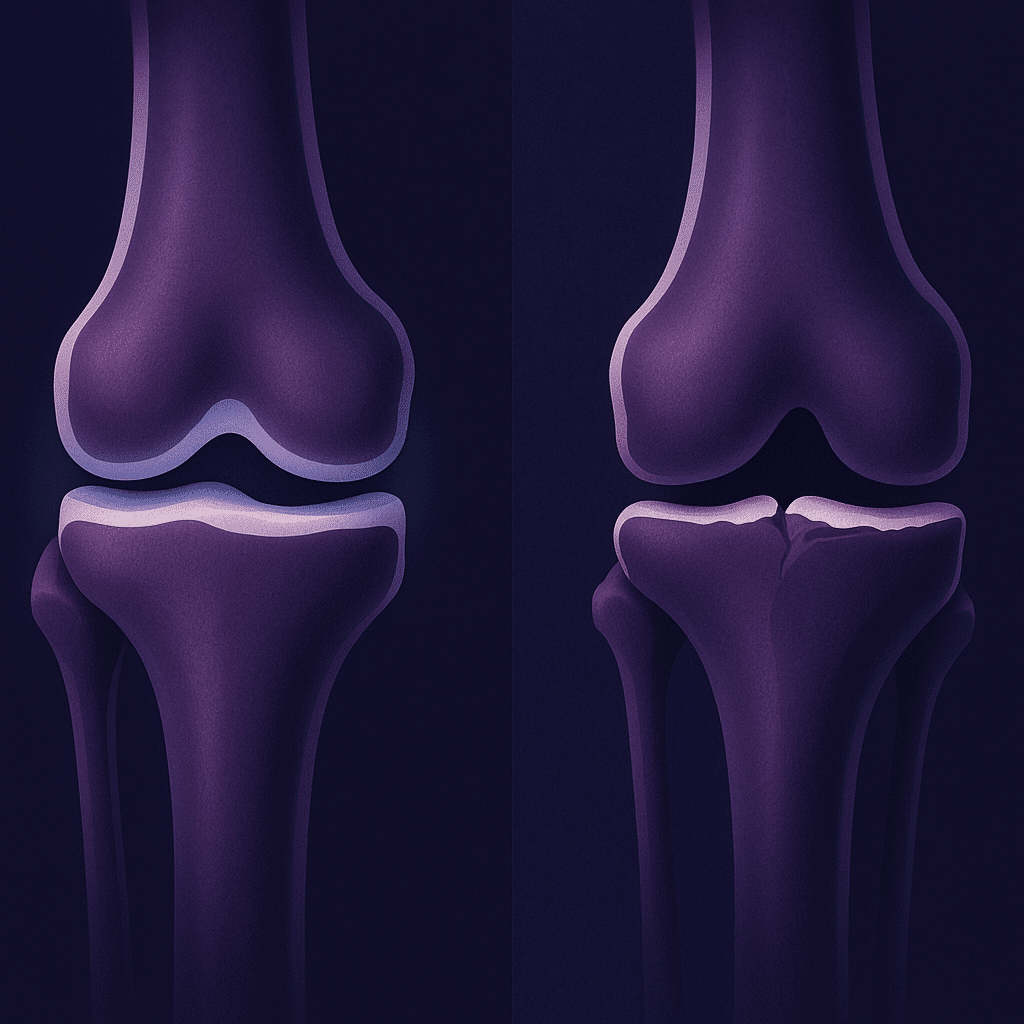
This is why Beyond Stem Cells asks patients from Littleton, Denver, Highlands Ranch, Centennial, Englewood, Lakewood, Aurora, Parker, Castle Rock, Lone Tree, Golden, Arvada, Westminster, Thornton, Broomfield, Boulder, Evergreen and Morrison — the roughly 50-mile ring it serves — to bring imaging to the first visit. The exam confirms what the picture suggests; the picture decides whether there is anything to confirm.
Am I too old for stem cell or PRP therapy? (No fixed age limit)
There is no age cut-off for PRP or stem cell procedures at Beyond Stem Cells. The question people are really asking is whether an older body heals well enough for the treatment to matter, and the honest answer is: it varies, and age is a weak predictor compared with imaging and general health.
A 72-year-old with moderate knee arthritis, a healthy weight, and cartilage on the X-ray is a better candidate than a 45-year-old with a bone-on-bone joint. What age does change:
- Healing capacity and platelet quality vary between individuals, and can decline with age — an older patient may need more sessions or a longer timeline.
- More medical exclusions tend to accumulate with age (anticoagulants, diabetes control, cancer history), and those — not the birthday — are what can disqualify.
- Expectations shift: the goal for a 75-year-old is often walking the dog without pain and staying off the surgical table, not returning to competitive sport.
At the other end, younger patients are not automatically better candidates. A young athlete with a complete ligament tear needs a surgeon, not an injection.
Medical reasons you may be screened out
A responsible clinic says no more often than its marketing suggests. Typical exclusions:
- Active cancer or cancer under current treatment.
- Active infection — systemic, skin over the injection site, or in the joint.
- Blood or platelet disorders that affect clotting or platelet function (PRP depends on healthy platelets).
- Certain immune or inflammatory conditions, evaluated case by case.
- Uncontrolled diabetes.
- Anticoagulant therapy that cannot safely be paused around the procedure.
- Pregnancy.
- Recent corticosteroid injection in the same joint — often a waiting period applies.
- Unable to pause workouts for two weeks after the injection — the cells need to stay in the joint space.
- Unrealistic expectations — needing a guaranteed or permanent result to justify the cost.

What happens at a candidacy consultation in Littleton (and who drives in for it)
The clinic is at 5912 S Cody St, Suite 201, Littleton, CO 80123, in the southwest Denver metro near Bowles and Wadsworth. Most patients come from within about 50 miles — Denver proper, Highlands Ranch, Centennial, Aurora, Lakewood, Golden, Arvada, Westminster, Boulder, Castle Rock, Parker, Evergreen and Morrison. Farther than that, ask for a phone screen first. The visit is free and runs in a fixed order, so you know what you are walking into:
- History and medications — the exclusion list above, plus prior injections and surgeries.
- Imaging review — bring your X-ray or MRI on disc or through your patient portal. If you have none, you will be told which to get.
- Physical exam — range of motion, stability, where it actually hurts.
- The candidacy answer — which row of the table you are in, and why. The medical director approves every treatment plan before anything is scheduled.
- If yes: which procedure fits (PRP or a stem cell procedure), how many sessions are typical, the price ($1,500 per treatment or four for $5,000 — see pricing), and a realistic best and worst case — never a percentage.
- If no: a straight referral toward the right option, usually a surgical opinion. See stem cell therapy vs. surgery.
Every treatment is ordered and supervised by a licensed physician; the team is listed on Meet Our Medical Team, and Colorado licenses can be checked through DORA in about two minutes. The program itself runs under independent IRB oversight.

Frequently asked questions
Who is not a good candidate for stem cell therapy?
People whose joint has no cartilage left, whose tendon or ligament is fully torn, or who have active cancer, active infection, uncontrolled diabetes, certain blood or immune disorders, or blood-thinner regimens that cannot be paused. Also anyone who needs a guaranteed result.
Am I too old for stem cell therapy?
There is no fixed age cut-off. Candidacy is decided by imaging and overall health, not birth year. Patients in their 70s with cartilage remaining can qualify; patients in their 40s with a bone-on-bone joint usually do not.
How do you qualify for stem cell therapy?
Through an in-person exam and a review of recent imaging (X-ray or MRI). The clinician confirms there is tissue for the treatment to act on, screens for medical exclusions, and explains what a realistic outcome range looks like before anything is scheduled.
Can you be too old for PRP?
No formal age limit applies to PRP. Platelet quality and healing capacity vary between individuals, so an older patient may need more sessions or a longer timeline, but age alone does not disqualify anyone.
Does Beyond Stem Cells see patients from outside Littleton?
Yes. The Littleton clinic serves the Denver metro and foothills within roughly 50 miles — Denver, Highlands Ranch, Centennial, Aurora, Lakewood, Golden, Arvada, Westminster, Boulder, Castle Rock, Parker, Evergreen and Morrison. Patients farther out can start with a phone screen to avoid a wasted drive.
Do I need an MRI before regenerative joint therapy?
Recent imaging is needed before a candidacy decision. An X-ray shows joint space; an MRI shows cartilage, tendon, and ligament detail. If you do not have imaging, the clinic will tell you what to obtain first.
Find out which row you are in
Free candidacy consultation in Littleton — serving Denver, Highlands Ranch, Aurora, Lakewood, Golden, Boulder, Castle Rock and everywhere within about 50 miles. Bring your imaging.
(833) 720-7836 · beyondstemcells.com · Directions
5912 S Cody St, Suite 201, Littleton, CO 80123 · Tue–Sat 9am–5pm
Medical disclaimer. Reviewed by Dr. Michael Iannotti, MD, supervising physician, Beyond Stem Cells. This page is general education, not medical advice, and does not create a doctor–patient relationship. Candidacy is determined only by an in-person evaluation. Stem cell and PRP procedures for orthopedic conditions are not FDA-approved treatments; individual results vary and no outcome is guaranteed. Colorado licenses can be verified through the DORA public lookup.