
Grow Young With Us
Stem Cell Therapy vs Cortisone Shots for Knee Pain in Littleton & Denver
The question most people are really asking is not “which is better.” It is “how many more of these am I going to need?” Beyond Stem Cells hears it from knee patients across Littleton, Denver and the southwest metro at its Littleton clinic.
You have had a cortisone shot. It worked. Then it wore off, and you went back, and it worked again — for slightly less long. Somewhere around the second or third round, most people start wondering whether they are treating the knee or just muting it.
That instinct is worth taking seriously, and it is the honest starting point for this comparison.
Quick Answer
Cortisone and regenerative therapy do different jobs. A cortisone injection is an anti-inflammatory. It calms the joint, and it usually works quickly. Regenerative therapy aims at the tissue instead, and works slowly: Beyond Stem Cells reports gradual improvement in its knee patients typically between 4 and 12 weeks, with results often lasting 2 to 5 years or longer. Neither replaces surgery for a bone-on-bone knee.
Stem cell therapy for knees near Littleton and Denver
If you have had a cortisone shot and want a straight answer on the regenerative option, that answer comes from a physician who has looked at your knee. The clinic is at 5912 S Cody St, Suite 201, Littleton, CO 80123, in the southwest Denver metro, and sees patients from Denver, Littleton, Englewood, Highlands Ranch, Centennial, Lakewood, Ken Caryl, Columbine and Lone Tree. Call (833) 720-7836 or book a complimentary consultation. Service details are on the knee pain treatment in Denver page.
TL;DR
- Cortisone: fast relief, anti-inflammatory, temporary, repeat use generally limited and spaced out.
- Regenerative: slow onset, aimed at the tissue, Beyond Stem Cells reports 4–12 weeks to gradual improvement.
- Duration: Beyond Stem Cells reports results often lasting 2–5 years or longer, with most knee patients needing only one session.
- Candidacy: regenerative options suit mild to moderate damage or early arthritis — cartilage worn but present.
- Money: cortisone is commonly covered; regenerative treatment is generally elective and out of pocket.
- They are not mutually exclusive. Previous cortisone does not automatically rule out regenerative treatment. Bring the dates.
- Individual results vary. No outcome is guaranteed.
- Where: Beyond Stem Cells, 5912 S Cody St, Suite 201, Littleton, CO 80123, in the southwest Denver metro. Serving Denver, Littleton, Englewood, Highlands Ranch, Centennial, Lakewood, Ken Caryl, Columbine and Lone Tree.
The clearest way to see the difference is to stop comparing them on relief, and compare them on what each is actually trying to do.
Different targets, not different brands of the same thing
Both arrive by needle into the same joint, which is why they get discussed as competitors. They are not really competing. They are aimed at different parts of the problem.
What a cortisone shot on the knee is doing
A corticosteroid injection is an anti-inflammatory. Inflammation in an arthritic knee is a substantial part of what makes it hurt, so reducing that inflammation reduces the pain. It generally acts within days, and that speed is a real clinical advantage — a knee that is acutely inflamed and stopping you from sleeping or walking is a knee that benefits from something fast.
What it does not claim to do is change the state of the tissue. When the anti-inflammatory effect fades, the joint is in much the same condition it was before. Repeat injections into the same joint are generally limited and spaced out rather than given on demand. The specific limit is a judgment for the physician managing your knee.
What regenerative therapy is doing
Regenerative treatment — stem cell growth factor therapy, PRP, PRF, exosome therapy and shockwave therapy — is aimed at the tissue rather than the inflammation. Beyond Stem Cells describes regenerative medicine as working with the body’s own healing mechanisms to repair injured tissue, reduce inflammation and restore function without surgery or general anesthesia.
Because that is a biological process rather than a pharmacological one, it is slower. Beyond Stem Cells reports its knee patients typically seeing gradual improvement between 4 and 12 weeks, with most needing only a single session and results often lasting 2 to 5 years or longer.
Cortisone answers “how do I get through the next few weeks.” Regenerative therapy answers “what happens over the next few years.” Those are both legitimate questions.
Side by side
| Cortisone injection | Regenerative knee injection | |
|---|---|---|
| Primary aim | Reduce inflammation | Support the tissue |
| Onset | Typically days | Gradual, typically 4–12 weeks† |
| Typical duration | Temporary; wears off | Often 2–5 years or longer† |
| Repeat use | Generally limited and spaced out | Most patients: one session† |
| Setting | In-office injection | In-office injection, no anesthesia† |
| Recovery | Minimal | Days to a few weeks† |
| Insurance | Commonly covered | Generally elective, out of pocket |
| Best suited to | An acutely inflamed, painful joint needing fast relief | Mild to moderate damage or early arthritis, cartilage worn but present† |
| Not a substitute for | Surgical assessment where the joint is bone-on-bone or structurally damaged | |
† Figures reported by Beyond Stem Cells at time of writing. Statements about corticosteroid injections are general clinical background. The physician managing your knee is the authority on your own injection history. Individual results vary.
When to look at alternatives to cortisone shots
Most people do not switch because a cortisone shot failed. They switch because of a pattern.
- The interval is shrinking. The first shot lasted months, the last one lasted weeks.
- You are being told to space them out and the knee is not making it to the next appointment.
- Somebody has mentioned replacement surgery but said you could wait a few years — and nobody has said what to do with those years.
- Physical therapy and weight management helped, then plateaued.
That “wait a few years” advice is the whole opportunity. Beyond Stem Cells states that early intervention produces the best results. The waiting period between “not bad enough for surgery” and “bad enough for surgery” is precisely the window where cartilage is still worn-but-present — which is the state regenerative therapy is aimed at. Spending that window doing nothing is a decision too.
Who each option actually suits
Cortisone is a reasonable choice when…
- The knee is acutely inflamed and you need it settled quickly.
- There is a specific short-term goal — a trip, an event, getting through a rehab block.
- You are early in working out what is wrong and buying time deliberately.
Regenerative therapy is worth a consultation when…
- Imaging describes mild to moderate arthritis, or cartilage thinning rather than absent.
- You are in the “not yet ready for replacement” gap and want to use it.
- You would rather have one appointment and a twelve-week wait than an appointment every few months.
- Pain is activity-related — stairs, distance, kneeling — rather than constant at rest.
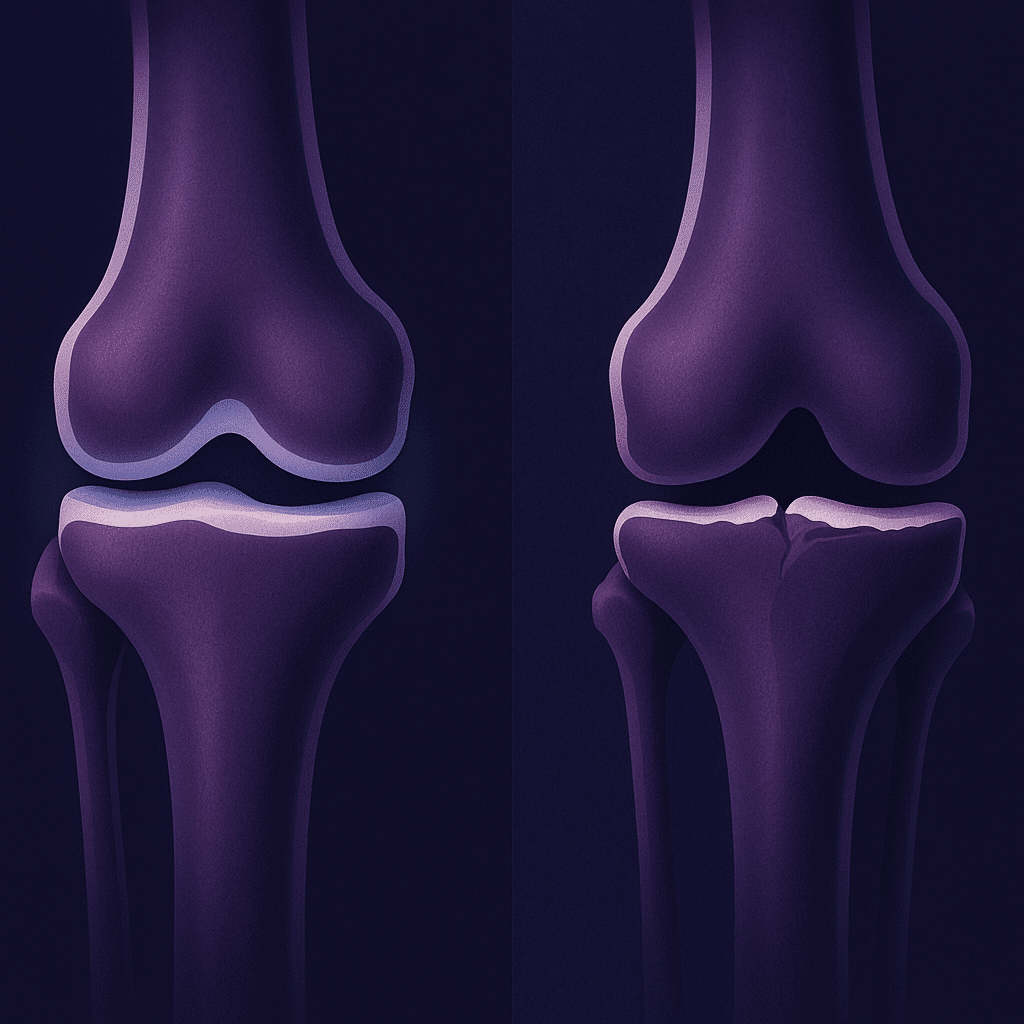
Neither injection is a substitute for surgery where surgery is indicated. If imaging uses the phrase bone-on-bone, or pain is constant at rest and at night, the right referral is a surgeon. Delaying a needed replacement to keep trying injections means more months of pain and more deconditioning for no gain. A consultation that ends in a surgical referral is a useful outcome.
What to bring if you want a straight answer
Beyond Stem Cells’ consultation is complimentary, and it is far more useful if you arrive with the history rather than the summary.
-
Your injection record
How many cortisone shots, in which knee, and the dates. Previous cortisone does not automatically rule out regenerative treatment, but it is relevant history and timing can matter.
-
Your imaging, not the verdict
The X-ray or MRI report itself. “The doctor said it’s arthritis” is not enough to work from. The grading and the cartilage description are what matter.
-
The pattern of your pain
Not a score out of ten. Stairs going down. After twenty minutes walking. First ten steps in the morning. That describes a knee; a number does not.
-
What you are actually trying to get back to
Skiing, a job on your feet, walking the dog without planning the route around benches. The goal changes which therapy is recommended.
Where to read further
If you want the full set of non-surgical routes rather than this one comparison, Beyond Stem Cells has mapped them in knee replacement alternatives. The step-by-step of the appointment itself is in what to expect from a stem cell knee injection, the coverage question is covered in does insurance cover stem cell therapy for knees, and the clinical page for the joint is knee pain treatment in Denver.
The program itself is IRB-approved, meaning protocols are formally reviewed and documented, and the research it works from is published at studies.
Frequently asked questions
What is the difference between a cortisone shot and stem cell therapy for the knee?
A cortisone injection is an anti-inflammatory. It reduces inflammation in the joint, which reduces pain, and it typically acts quickly. Regenerative therapy has a different aim: rather than suppressing inflammation, it is intended to support the tissue itself. That shows up in the timeline. Cortisone tends to act within days, while Beyond Stem Cells reports its knee patients typically see gradual improvement between 4 and 12 weeks.
Which works faster, cortisone or stem cell therapy?
Cortisone is generally faster, which is a genuine advantage when a knee needs to calm down quickly. Regenerative therapy is slower by design: Beyond Stem Cells reports gradual improvement typically between 4 and 12 weeks in its knee patients, with results often lasting 2 to 5 years or longer. Speed and duration are different questions.
How often can you get a cortisone shot in the knee?
Repeat corticosteroid injections into the same joint are generally limited and spaced out rather than given on demand, and the specific limit is a decision for the physician managing your knee. Patients asking this question are often at the point where a longer-term plan is worth discussing. Beyond Stem Cells reports that most of its knee patients need only a single regenerative session.
Can I have stem cell therapy if I have already had cortisone shots?
Previous cortisone injections do not automatically rule out regenerative treatment, but they are relevant history and timing can matter. Bring the dates and the number of injections to your consultation. Candidacy is determined at a complimentary consultation in Littleton, CO, and rests mainly on whether cartilage is worn but still present.
Is stem cell therapy better than cortisone for arthritis?
Neither is universally better. They do different jobs. Cortisone is useful for calming an inflamed joint quickly. Regenerative therapy is aimed at knees with mild to moderate damage or early arthritis where cartilage is worn but still present, and Beyond Stem Cells reports results often lasting 2 to 5 years or longer. Where the joint is bone-on-bone, neither injection substitutes for surgical assessment.
Does insurance cover either option?
Corticosteroid injections are a long-established, commonly covered treatment, whereas regenerative joint treatments are generally treated as elective and paid out of pocket. Plan terms vary considerably. Confirm both directly with your own carrier.
How long does a cortisone shot last in the knee?
Relief from a cortisone shot is temporary. How long it lasts varies from person to person and from one injection to the next, and repeat injections into the same knee are generally limited and spaced out rather than given on demand. If the gap between your shots keeps getting shorter, that pattern is worth bringing to a consultation.
Where can I get stem cell therapy for my knee near Denver?
Beyond Stem Cells is at 5912 S Cody St, Suite 201, Littleton, CO 80123, in the southwest Denver metro, and sees knee patients from Denver, Littleton, Englewood, Highlands Ranch, Centennial, Lakewood, Ken Caryl, Columbine and Lone Tree. Candidacy is decided at a complimentary consultation; call (833) 720-7836 to book one.
Stop guessing how many more shots you need
The consultation is complimentary. Bring your injection history and your imaging, and get a straight answer about which option your knee is actually a candidate for.
(833) 720-7836
Book a free consultation
Knee pain treatment in Denver
Beyond Stem Cells Medical Spa · 5912 S Cody St, Suite 201, Littleton, CO 80123
Tuesday–Saturday, 9:00am–5:00pm · Serving Denver, Littleton, Centennial, Englewood, Highlands Ranch and Lakewood
Get directions → ·
See patient results →
Medical disclaimer. This article is general information comparing two treatment approaches for knee pain and is not medical advice, a diagnosis, or a treatment recommendation. Statements about corticosteroid injections are general clinical background; decisions about your own injection history, frequency and suitability rest with the physician managing your knee. Regenerative therapies are not appropriate for every patient, are not a substitute for surgery where surgery is indicated, and no outcome is guaranteed. Individual results vary. Timelines, durations and session counts attributed to Beyond Stem Cells reflect figures published by the clinic at time of writing and are subject to change. Insurance coverage varies by plan and carrier. Confirm directly with your own. Every treatment plan begins with an in-person consultation to determine candidacy.